
Utah Arrest Warrants Explained
Utah calls an arrest warrant a written order from a judge or magistrate allowing police to take someone into custody in a criminal case. A magistrate is a judicial officer with the power to make certain warrant and release decisions. Under Utah Code §77-7-5, that officer may issue a warrant instead of a summons only after finding probable cause and deciding a warrant is needed to prevent injury, secure the person's appearance, or protect public safety or welfare. The order must also name a law-enforcement agency with jurisdiction to serve it. That statutory test sets an arrest warrant apart from a routine notice to appear. Utah's District Court is the general-jurisdiction trial court and usually handles felonies. County and municipal Justice Courts take the cases within their lower-level jurisdiction, and a judge or magistrate in either can issue a warrant where the law allows. Whichever Utah court issues the order keeps its case record and controls any recall. The Utah Department of Public Safety and its Bureau of Criminal Identification run the statewide information file, but they have no say in whether a local judge issues or withdraws a warrant. Because the charge and the proceeding determine where the record starts, match the court named in a notice or case result to the right clerk. The Utah Courts District Court overview lays out that court's place in the statewide structure.
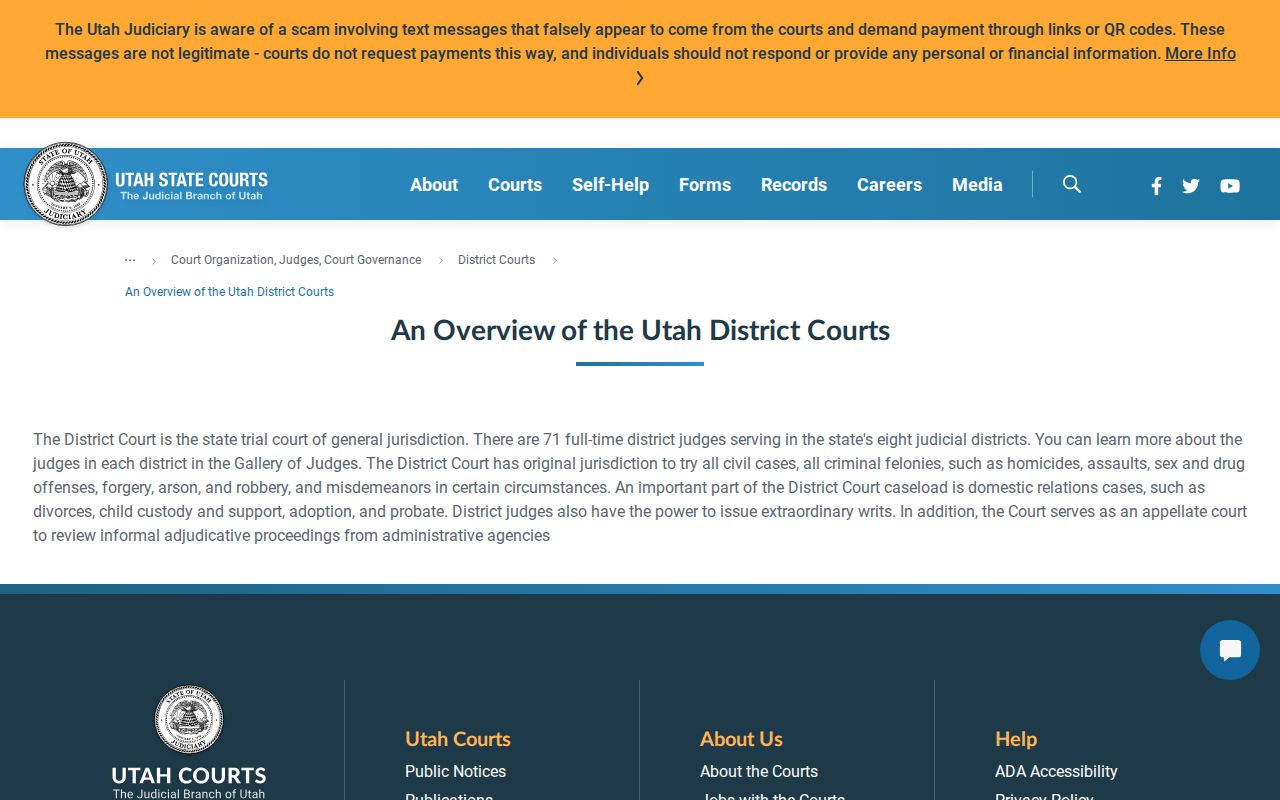
Utah District Court jurisdiction is one part of the route. The Utah docket and judge still control the individual warrant.
Utah Rule 6 Guides Arrest Warrant Issuance
Utah Rule of Criminal Procedure 6 governs how a criminal case gets an arrest warrant and how release conditions are handled. The process starts with a complaint or other charging document filed in a Utah court with jurisdiction. A judge or magistrate then reviews sworn facts or other information the rule permits, weighing whether the probable-cause standard is met and whether the case calls for a warrant rather than a summons. The rule also spells out what the order must contain. This is a case-specific judicial decision in Utah, never an automatic byproduct of a charge being filed. A summons, by contrast, tells a person to appear without first authorizing an arrest. When a warrant does issue, the order identifies the agency allowed to act on it. A judge may set release conditions, though Utah sets no one statewide arrest-warrant amount that fits every charge or case. The exact Utah order and the court decisions that follow are what matter. The official Utah Rule 6 text gives the procedural framework, and each Utah court applies it to the facts of its own case. Reading the rule will not tell you whether a particular warrant remains active.
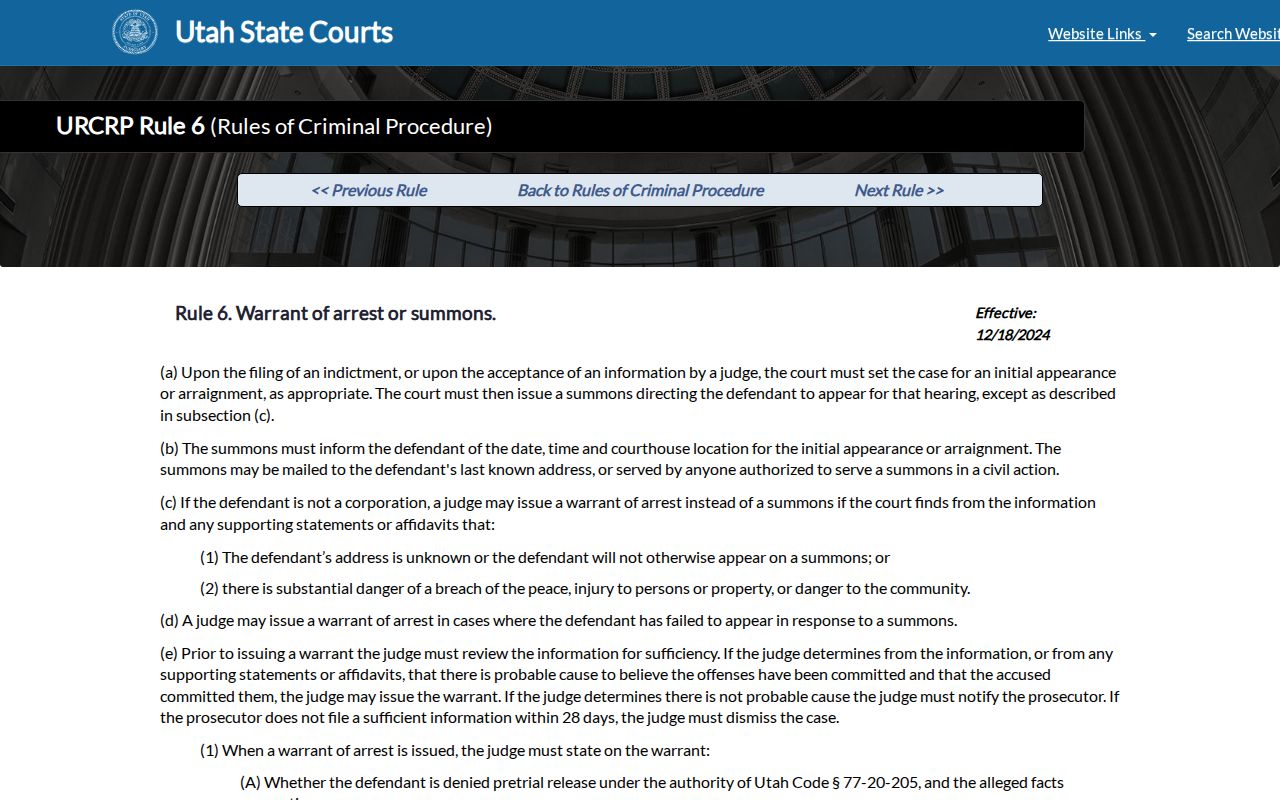
For one case, ask the Utah clerk which court event or release condition comes next.
Inside a Utah Arrest Warrant
A Utah public search result can show less than the court file or the restricted law-enforcement record. BCI's official Utah training example displays a name, age, case number, court name, and the charge or charges. Internal UCJIS records in Utah can hold more: added identifiers, service history, comments, and recall data. Those internal fields are not all public search fields, and they should not be expected on every result. Use the visible Utah case details to identify the right record, then ask the issuing court to confirm the warrant and the next steps. This field table describes the limits of a public-facing Utah result based on official examples, not every field an officer or court user may see.
| Name and age | Shown in the official public demonstration; match carefully with the court and case details. |
|---|---|
| Case number | Public case identifier shown in the demonstration; give it to the issuing clerk when asking about the docket. |
| Court name | Identifies the court that holds the case record and controls a recall request. |
| Charge or charges | May appear in the public result; the court docket is the place to confirm current case details. |
| Service and recall | Internal system fields may track these events, but a public demonstration does not establish that every operational detail is displayed. |
| Bond, judge, issue date | Do not assume these appear in the public search; confirm release terms and dates with the court. |
A warrant entry only authorizes legal process in Utah. The underlying criminal case remains for the court to resolve.
Utah Felony Warrants Usually Begin in District Court
Utah runs its courts through eight judicial districts, and the District Courts carry general jurisdiction as trial courts. Felony cases live there. So do felony arrest warrants, most of the time, though the right Utah court still depends on the charge and the proceeding. Justice Courts issue warrants too, within their own authority. That split explains something practical: no single Utah clerk can confirm every arrest warrant statewide. Warrant data flows into the system from the courts themselves, arriving by electronic transfer from CORIS, the case-management platform, and by Justice Court entries through the Warrant Management System (WMS). Those feeds populate Utah Statewide Warrants (SWW) inside the Utah Criminal Justice Information System (UCJIS), which BCI administers with quality oversight. The shared index helps, but the issuing court keeps the case and decides any recall. BCI is an administrator, not a statewide clerk or warrant issuer. For a free statewide name search, BCI's public Utah warrant search page is the entry point. To route a question to the right court or sheriff, the Utah Courts directory lays out the hierarchy and local contacts. Keep one point in mind: the index collects court-originated information, and the issuing court remains the source for its own case and warrant order.
Serving Arrest Warrants in Utah
Serving an arrest warrant in Utah falls to sheriffs, municipal police, and other authorized law-enforcement agencies, each within its jurisdiction and assignment. The warrant names an agency. That named agency is the one to ask. BCI administers Utah's information system but does not serve warrants for the public. A sheriff can walk through booking and service questions, while a clerk handles the court case and the judge's order. Timing rules differ by charge. Utah Code §77-7-5 allows a felony warrant to be served at any time, but nighttime service of a misdemeanor warrant carries statutory limits tied to the warrant's endorsement and circumstances, so resist any blanket claim that every misdemeanor warrant can hit any hour. Officers follow the warrant and the governing law. Once an arrest happens, the Utah case returns to a magistrate or court for appearance and release decisions. Utah Rule 9A steps in when a person cannot meet release conditions: an appearance before a magistrate is required within 48 hours, with court consideration no later than the third day after arrest, subject to the rule's terms. Those deadlines govern the post-arrest process only. They set no universal bond and decide nothing about the merits of the charge. Remember that the serving agency, the issuing court, and the agency maintaining the statewide index each hold separate roles in a Utah arrest warrant.
Utah Felony Warrant Records Can Also Enter NCIC
Utah BCI training says felony warrant records in the court system have gone to the FBI's National Crime Information Center (NCIC) since April 2020, under Utah Code §53-10-214. Each NCIC entry ties to the responsible agency's ORI, its Originating Agency Identifier. That federal index sits apart from the public Utah Statewide Warrants search. The Utah BCI warrants training documents the state-system flow. The reporting rule behind it appears in Utah Code Title 53, Chapter 10. Neither source turns NCIC into a public warrant lookup. An NCIC entry adds no second court order either. It does not shift which Utah court issued the warrant. It gives the public no new search method. NCIC stays closed to name searches by the public. Its internal query fields are not features of BCI's public portal. The Utah court still controls the case and any recall. Law enforcement keeps its service and national-system records under authorized access.
A Utah SWW Record May Need a Court Recall After Service
In Utah, service and recall are two different system events. Recall means the issuing court formally withdraws its warrant. Law enforcement reports that a warrant was served, but only the court controls recall and updates its own case record. The Utah BCI manual revised in December 2025 describes the timing: a court-recalled entry leaves UCJIS within about one hour, while a served record can linger in Utah's state system for roughly 15 days if the court has not recalled it. Those are manual timing descriptions. They do not promise that every public result refreshes on a fixed schedule. The Utah data path runs from the court case system into SWW in UCJIS, with service information returned by law enforcement and recall handled by the court. A payment receipt, a booking event, or a promise to appear does not by itself prove the court entered a recall. Ask the Utah clerk three things: whether the warrant is recalled, whether the case needs another appearance, and whether an update is still pending. If a search result clashes with a court notice, start from the court's docket to get it corrected. A Utah public result is not a certified release decision either. It may omit court conditions, service details, or later changes. The Utah court can provide its own accessible record, and under BCI's manual, one court cannot confirm another court's warrant. For county-level service details, the Utah county directory routes you to the responsible sheriff or court. Just remember that "served," "recalled," and "removed from the state file" mark separate points in Utah's warrant-update process.
Comparing Arrest, Summons, and Bench Warrants
Utah labels these tools differently, and the label matters. An arrest warrant in Utah rests on the standard courts apply when a criminal case begins. A summons just tells a person to show up, with no arrest power behind it. A Utah bench warrant comes later, after something like a missed appearance, and it can appear in a traffic, ordinance, or criminal case. The court and case record tell you which instrument is in play.
| Item | Arrest warrant | Summons | Bench warrant |
|---|---|---|---|
| Why it issues | Probable cause and statutory need for a warrant rather than a summons | Court process directs the person to appear | Missed appearance or noncompliance when the court may issue a warrant |
| What it authorizes | Arrest under the judicial order | Appearance on the stated date or terms | Arrest tied to the court event and its order |
| Who controls the file | The issuing court and its clerk | The court handling the case | The court that issued the bench warrant |
| What to confirm | Current status and release conditions | Appearance date and response required | Recall, payment, appearance, or other court instruction |
Utah calls most missed-date matters a "bench warrant" or a "warrant for failure to appear." Some other states say capias for certain arrest or post-judgment fine warrants; Utah does not use that as its general FTA term. A search warrant is different too. It authorizes a hunt for evidence, not the arrest described here.
Contact Utah's Issuing Court Before a Voluntary Appearance
Before you walk into a Utah courthouse or sheriff's office, find out which court issued the warrant and what it wants from you. The free Utah Statewide Warrants search works as a first name check; after that, call the court named in the result or on your case papers. An archived official Utah public search capture shows a required first and last name, an optional middle initial, and a CAPTCHA, though it does not establish every current field. Utah Courts' Xchange system adds case context for eligible records, but it is no warrant-clearance certificate. The Utah court itself can explain its own case, and BCI's manual notes that one court cannot disclose another court's warrant.
When online tools fall short, a written request under Utah's court-record rules can seek an accessible copy from the issuing clerk. The Utah Courts request-a-record instructions walk through the process. Courts generally answer within 10 business days, subject to access rules and how the record is classified. Juvenile, sealed, private, and protected material may be withheld or redacted. A records request explains a case; it does not recall the warrant or excuse an appearance. For an agency-held record, such as releasable BCI or sheriff material, use that agency's Government Records Access and Management Act (GRAMA) route: BCI's records request page describes its process, though statutory limits mean a GRAMA request does not guarantee access to an internal UCJIS record. For court copies, start with the issuing clerk. For local service questions, the Utah county directory points to the sheriff and court channel. Note: a public search, a court case copy, and a restricted UCJIS record are three different kinds of access in Utah.
If There Is an Arrest Warrant for You
A Utah public result or court notice pointing to an arrest warrant is a starting point, not the last word. First confirm the issuing court and the warrant's current status. Utah's free BCI name search helps here, but a blank result does not replace checking with the Utah court that handled the case. Reach the clerk through the official Utah court directory, or use the Utah county directory to find the local court and sheriff. Remember that a different court cannot confirm the warrant for the issuing court.
Ask the Utah court what event is required, whether a hearing or motion is needed, and what release conditions apply. Utah has no single statewide surrender window, walk-in process, or recall form. The Utah sheriff can explain service or booking logistics, while the judge controls the order itself. A lawyer can review the case and advise on appearance, surrender, bond, or a request to recall the warrant. A bond is a court-ordered financial condition for release or appearance, and paying it does not by itself dispose of the Utah case. Never assume payment alone closes the warrant or that an online update has already posted. The Utah Insurance Department bail-bond information covers professional licensing and oversight, not the bond terms in an individual warrant.
Confirm before you go. Check the location, required identification, next appearance, and any release terms with the official Utah court or county jail source.
Important: An active warrant can lead to arrest when law enforcement confirms it; ask the issuing court or a lawyer about surrender, appearance, and release terms before acting.