
Utah Active Warrants Explained
The public face of Utah's statewide warrant system is the Utah Statewide Warrants (SWW) search inside UCJIS, run by the Department of Public Safety's Bureau of Criminal Identification. Anyone can run a Utah name search there. It suits two jobs well. Check your own status, or make sense of a relative's Utah court notice. Treat the result as an index into court activity. It is not a complete list of every Utah warrant, and it cannot promise that a listed record is still active. The court that issued the order holds the real case file. Only that Utah court controls a recall. Justice Courts, District Courts, and Juvenile Courts across Utah each manage their own case categories, while sheriffs and other authorized agencies handle service. A Utah county website may answer local questions, but no single county roster represents Utah statewide. Read the Utah court named on the result or citation, then route through the Utah county directory for confirmation and next steps.
Utah Statewide Warrants Covers Multiple Warrant Classes
Utah Code §53-10-208 puts the Utah statewide warrants system in BCI's hands. The statute names felony warrants plus class A, B, and C misdemeanors and certain traffic-citation failure-to-appear records. BCI's December 2025 manual describes the Utah SWW file more broadly. It covers outstanding felony, misdemeanor, and infraction warrants. Those two scopes do not match. Utah publishes no participation map reconciling every category or court. So a public Utah search is a broad state resource, but it is not proof that every local record is included.
| Source | Documented Scope | Reading Limit |
|---|---|---|
| Utah Code §53-10-208 | Felony, class A/B/C misdemeanor, specified traffic-citation FTA, and certain protective-order records | Statutory categories do not provide a public county-by-county participation map. |
| Utah BCI SWW manual | Outstanding felony, misdemeanor, and infraction warrants | Operational manual scope is not a public completeness promise. |
| Utah public search | Free Utah name search linked by BCI | Not a certified clearance, court docket, or documented historical search. |
Read the Utah warrants statute and BCI's public warrant-search page for the state's own descriptions. The Utah public interface displays the statewide lookup screen.
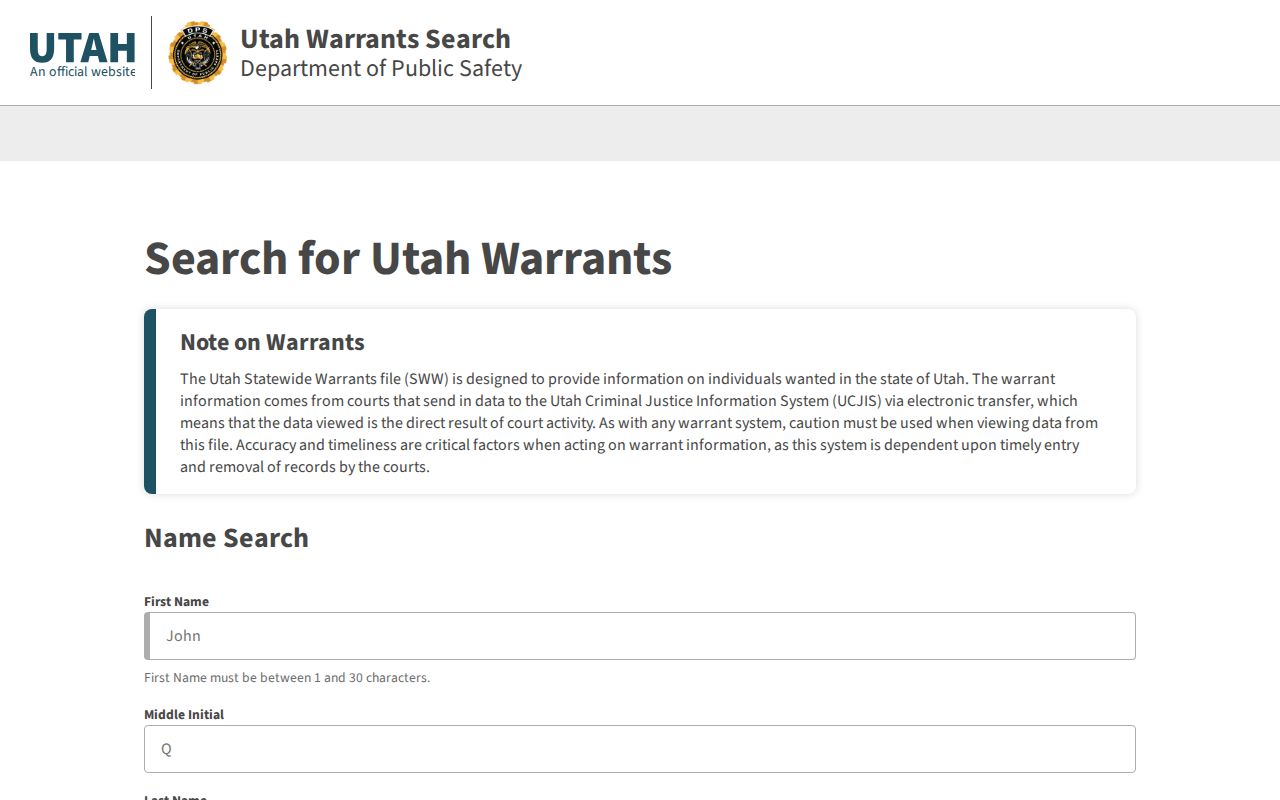
That screen is only the search channel. It promises nothing about what any Utah warrant file contains or how recently a record was updated.
How Utah Tracks Active Warrants
Utah court activity flows into UCJIS through case-system feeds. CORIS pushes court records into the statewide stream. Justice Courts in Utah may enter warrants through the Warrant Management System (WMS). The BCI Statewide Warrants manual spells out each system's duties for Utah courts and law-enforcement agencies. BCI administers the Utah SWW file. Its work covers audits, training, and quality control. It never issues or recalls a court order. Each Utah court handles record entry and recall. Law enforcement updates service events. That split explains a common confusion. A docket, a statewide result, and an agency's service log can each show a different stage. Utah publishes no public refresh schedule or daily update promise. The December 2025 manual describes procedures, not per-record date stamps. There is no searchable history range and no official count of open warrants. When a Utah record matters to a case, ask the issuing Utah court directly, even if the public result looks old or missing.
Note: Utah does not publish a statewide freshness schedule, so a search time cannot be treated as the court's current docket status.
A Utah Court Recall and a Police Service Update Are Separate
"Served" and "recalled" mark two different events in Utah's warrant process. A recall withdraws the court's order. Only the Utah court enters it. Law enforcement reports the service or arrest instead. BCI's December 2025 manual adds timing detail. A Utah court-recalled SWW record leaves UCJIS within about an hour. A served record can linger for roughly 15 days if the court has not recalled it. Those timings describe the system, not a portal refresh guarantee for every case. Payment, appearance, service, and recall are not interchangeable in a Utah case either. Paying a balance is not the same as a recall. A person who paid or was served should still ask the Utah court what action it entered. Ask whether another appearance is required. If the Utah case record looks stale, hand the clerk the receipt or order and request current status. A sheriff can answer a service question. The Utah issuing court still controls the case and any recall.
Note: Utah's approximate one-hour recall and 15-day served-record intervals come from BCI's manual, not a live public-service commitment.
Inside an Active Warrant Record
Utah BCI training material shows two views of one record. The public demonstration page is thin. It carries a name, age, case number, court name, and charge information. The internal UCJIS record is far richer. Not every Utah search result looks the same. Public results do not expose every internal field. Treat the Utah court and case reference as the useful route to confirmation.
| Warrant reference | Court-confirmed reference The public format was not documented; rely on the issuing Utah court's identifier. |
|---|---|
| Name and age | Shown in the official public demonstration. Other personal identifiers may belong to restricted internal records. |
| Case number | Shown in the demonstration; give it to the Utah court clerk when asking about the case. |
| Court name | Shown in the demonstration and identifies the Utah court that maintains the case. |
| Charge information | Shown in the demonstration, but public detail can differ from internal system fields. |
| Status and service | The Utah internal file has status and service data; those are not documented public filters or guaranteed display fields. |
Do not read a bond, judge, service limit, or expiration date into a general search result. The Utah court's case file governs release and recall. It also tells you what remains due.
What “Active” Means in Utah's SWW File
When BCI marks a Utah warrant entry as active, it means the order is still outstanding in the state file. That label is a system status. It says nothing about the next hearing or what a person must do next. A served entry records law-enforcement action. A recalled entry means the Utah court pulled the warrant back. For whether a case stays open, ask the Utah clerk who holds the file.
- Active
- Still outstanding in the Utah file; verify with the issuing court.
- Served
- Law enforcement reports execution or service; the court case may still need attention.
- Recalled
- The issuing court withdraws the warrant and the UCJIS record is then removed through the system process.
- FTA
- Failure to appear or respond when the court required it; it can lead to a bench warrant under the applicable procedure.
Note: Utah's active label describes the statewide file and should be checked against the court's own current case record.
Warrant Roundups and Most-Wanted Lists
Utah runs no statewide warrant amnesty, and neither BCI nor DPS posts a curated Most Wanted roster for the whole state. The BCI SWW name search is a broad public warrant lookup. It is not a ranked list or a public notice aimed at particular people. Local Utah agencies do publish their own official notices at times. Those are limited selections. They never replace the Utah state search or the issuing Utah court's own file.
Key Point: Use the official Utah BCI warrant-search page for the Utah statewide public search; it is not a Most Wanted roster.
The federal U.S. Marshals District of Utah describes federal fugitive operations, including the multiagency VFAST layer. That is separate from Utah's state warrant index and is not a Utah state roster.
Note: Utah's DPS and BCI publish no curated Most Wanted roster, and no statewide warrant-amnesty period exists.
Utah's Public Search Is Not a Curated Most-Wanted Page
A statewide warrant index and a Most Wanted page answer two different questions. Utah's SWW search surfaces warrant information held in the state file. A curated page, where an agency runs one, picks only certain cases to invite public tips. Utah DPS and BCI post no statewide roster of that kind, no published selection rules, no statewide reward amount, and no Utah tip form. That gap is about the state agencies. It does not mean local police or federal authorities never publish notices of their own.
The U.S. Marshals Service runs national fugitive programs and keeps a Utah district office. Federal warrants and tips are not handled by Utah BCI, though. The official USMS tip page lists the current ways to submit information and make contact. In an emergency, call local emergency services. Treat any public list as a selection, never a complete Utah warrant search.
When Your Name Is on the Warrant List
If the Utah search seems to match your name, write down the case number and the court. Then confirm the entry with that Utah court directly. When a local notice lists a name, call the agency through a number from its official website. After that, ask the issuing court about the case behind the warrant. A public search or list cannot tell you whether the order was recalled, what payment or hearing is due, or whether a bond applies. The case belongs to the Utah court that issued the warrant, not to BCI.
The Utah county directory can connect you with the right local Utah court and sheriff channel. A Utah court may demand an appearance, a motion, payment, or some other step. Never assume a fine payment or a future date clears the warrant by itself. If the matter is contested or could lead to custody, talk with an attorney about the record and the safest way to appear.
Important: Confirm the Utah court's status and appearance instructions before acting; an attorney can help assess surrender, bond, recall, and the underlying case.
Why a Utah Court May Know More Than a Search Result
A Utah County Sheriff's warrant page shows one local service channel in action. Its practices do not set the rule for every Utah county. That page describes the sheriff's own warrant unit and links out to the BCI search. Another county may rely on a different online tool, a phone procedure, or a request form. The issuing Utah court remains the authority on its case and on any recall. Utah County Sheriff's warrant page offers one example of a local inquiry source.
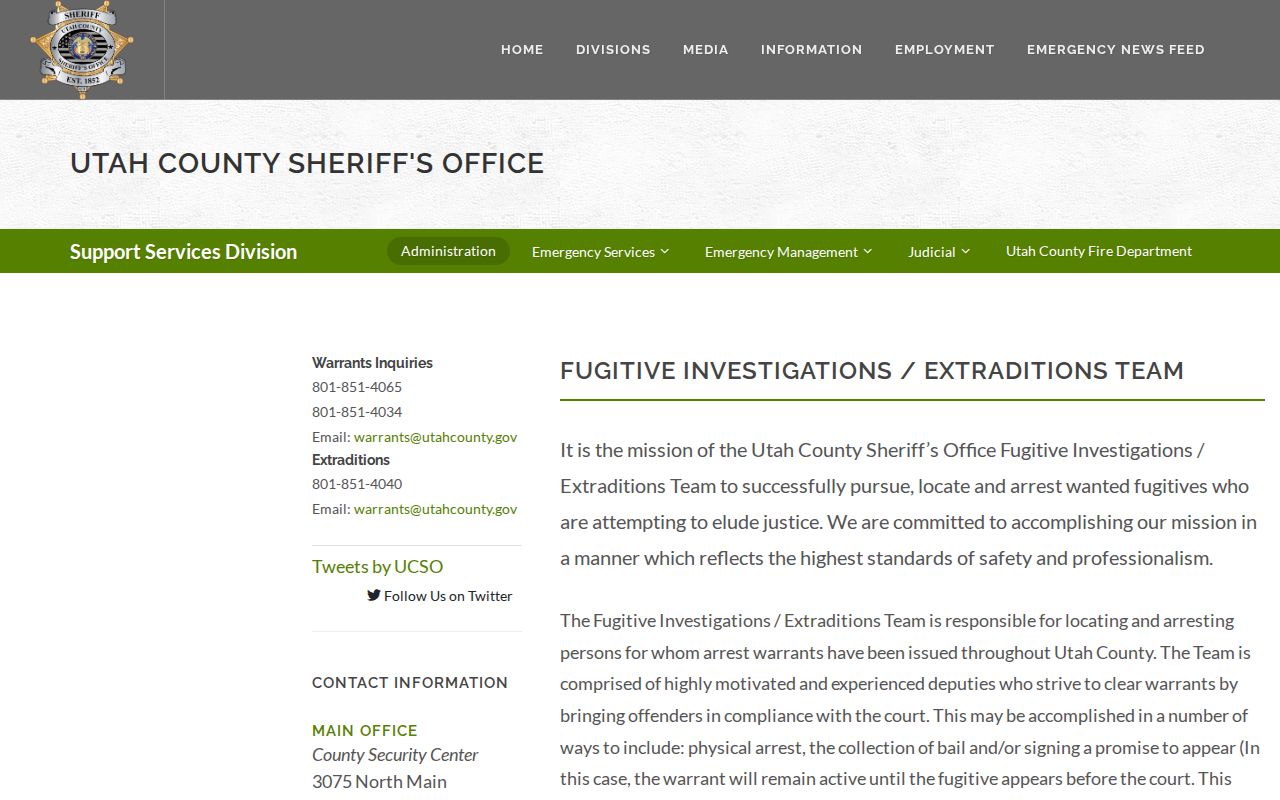
Start with the right county channel through the directory for any local service question. Then ask the Utah court named in the case about its current status and your next step.
The Utah SWW Search Does Not Publish Its Back-Date Range
Utah's Statewide Warrant system comes with real limits that nobody posts on a banner. The public description and the system manual give no date range for historical warrant records. They offer no public count of how many warrants the file holds. There is no field-by-field map of which Utah courts feed it, either. The archived view of the Utah search dates to 2021, and the manual was revised in December 2025. Neither date tells you how far back any result set reaches. Utah publishes no "current through" date for its results.
Those gaps matter when you are chasing an older citation. They matter just as much when you want to confirm a payment changed a court order. The Utah Courts case record may carry more history than the warrant list does. A Utah court clerk can also tell you whether the case is still open. If an old bench warrant might qualify for Utah's Rule 4-703 process, the court decides eligibility and enters its own order. Age alone never erases a warrant.
Note: A December 2025 manual revision date describes the document, not the start date or history depth of Utah's public warrant search.
Utah Juvenile Warrants Follow a Private-Record Route
Utah keeps juvenile court records under tight confidentiality rules. Title 80, Chapter 6 sets the baseline. Court classification rules add their own limits on top of it. So a blank result in a public Utah warrant search tells a family nothing about a restricted juvenile case, since the index simply does not carry it. The only way to learn whether such a case exists is to ask the Utah court directly and request authorized access. Sealing works differently again. Utah seals certain search-warrant application materials under Utah Rule of Criminal Procedure 40. These restrictions stand apart from each other, and a public index can never replace the access rules or a Utah court's own release decision. For an eligible public case record, the Utah court request process under UCJA Rule 4-202.04 is the right channel. Records held by BCI or a Utah sheriff go through that agency's GRAMA process instead. Criminal-history and warrant disclosure limits still apply there. And remember the core point: no request and no search result clears anything. Only the issuing Utah court can decide what case action a warrant requires.