
Inside the Utah Warrant System
Utah's warrant system runs on court activity. A judge or magistrate issues the order. The court keeps the case. Law enforcement serves the paper and reports back what happened. Sitting inside the Utah Criminal Justice Information System (UCJIS) is the Utah Statewide Warrants file, known as SWW, which shares covered state records with justice agencies and opens a limited public name search to anyone. That index is not the legal source of truth for every Utah case, though. The issuing court controls its own warrant and alone decides whether to recall it. BCI administers the system but never the court case, and a Utah county sheriff serving an order does not take over court ownership. For court and sheriff contacts in a specific area, use the County Directory.
BCI Administers Utah's Warrant System
The Utah Department of Public Safety's Bureau of Criminal Identification (BCI) administers SWW within UCJIS. Its duties cover quality control, audits, training, and support for authorized users. The Utah BCI public site links to the free name search. What it never does is issue a Utah arrest warrant, decide a motion, or recall an order. Those actions stay with the court that owns the case.
Utah DPS Bureau of Criminal Identification
BCI operates the statewide information layer and supports justice agencies. The issuing court remains responsible for the court record.
The BCI homepage carries current public agency information and its warrant-payment scam warning.
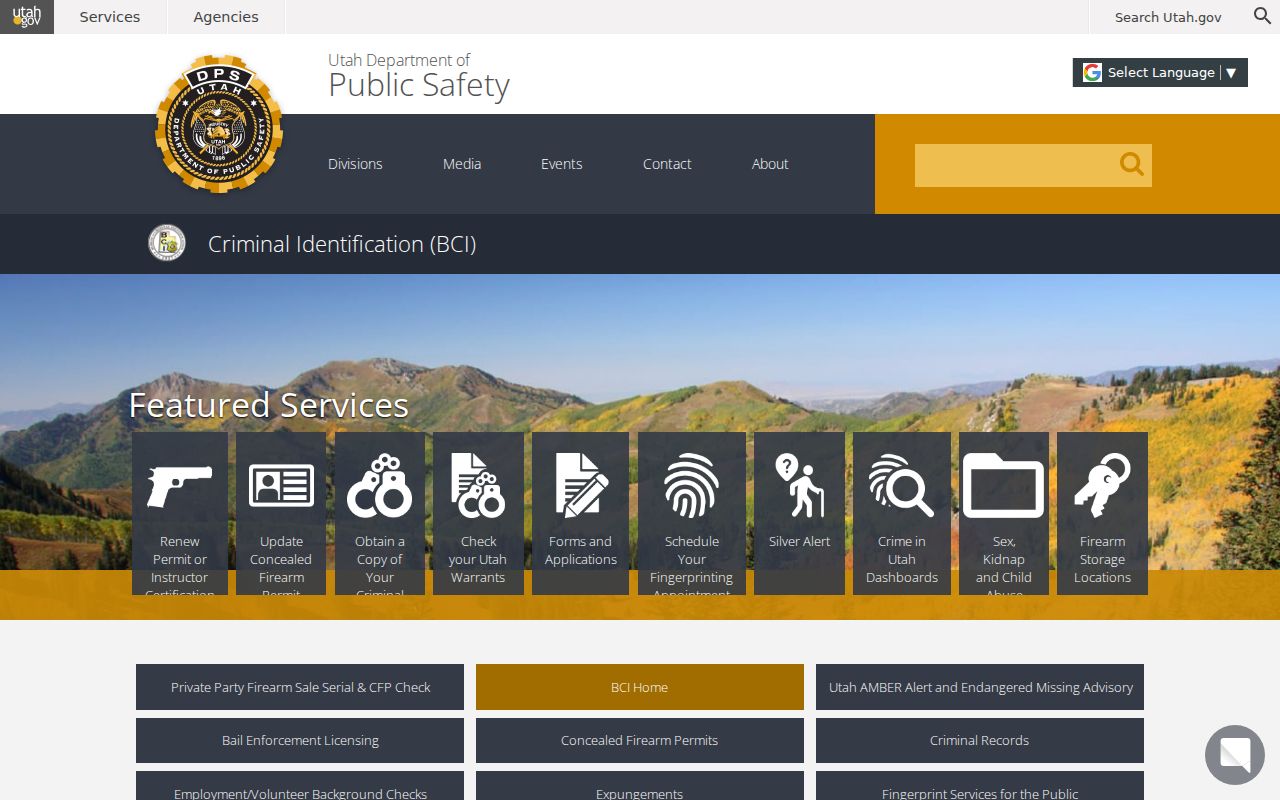
BCI's public page draws a clean line between the agency's system role and the court's. The agency says plainly that it does not call people to announce warrants or ask for fine payment. Note: Utah BCI administers the system, while the issuing court owns recall decisions for a Utah warrant.
Utah Statewide Warrant Databases
Utah's public route is a narrow window into the statewide file. BCI offers a free statewide name search. Internal UCJIS functions and NCIC stay restricted to authorized users, and PACER serves federal dockets. Each of these Utah record layers has its own purpose.
| System or Record | What It Holds | Run By |
|---|---|---|
| Utah SWW in UCJIS | Statewide warrant information; BCI describes outstanding Utah felony, misdemeanor, and infraction warrants | Utah DPS / BCI |
| NCIC | Some Utah felony warrant entries under an agency ORI; restricted law-enforcement access | FBI system, with the entering agency responsible for its record |
| Issuing court case file | The Utah case, warrant order, and court action or recall | The Utah court that issued the warrant |
| PACER | Public federal docket records, not an operational state warrant index | Federal Judiciary |
BCI's Check Your Utah Warrants page links to the public search.
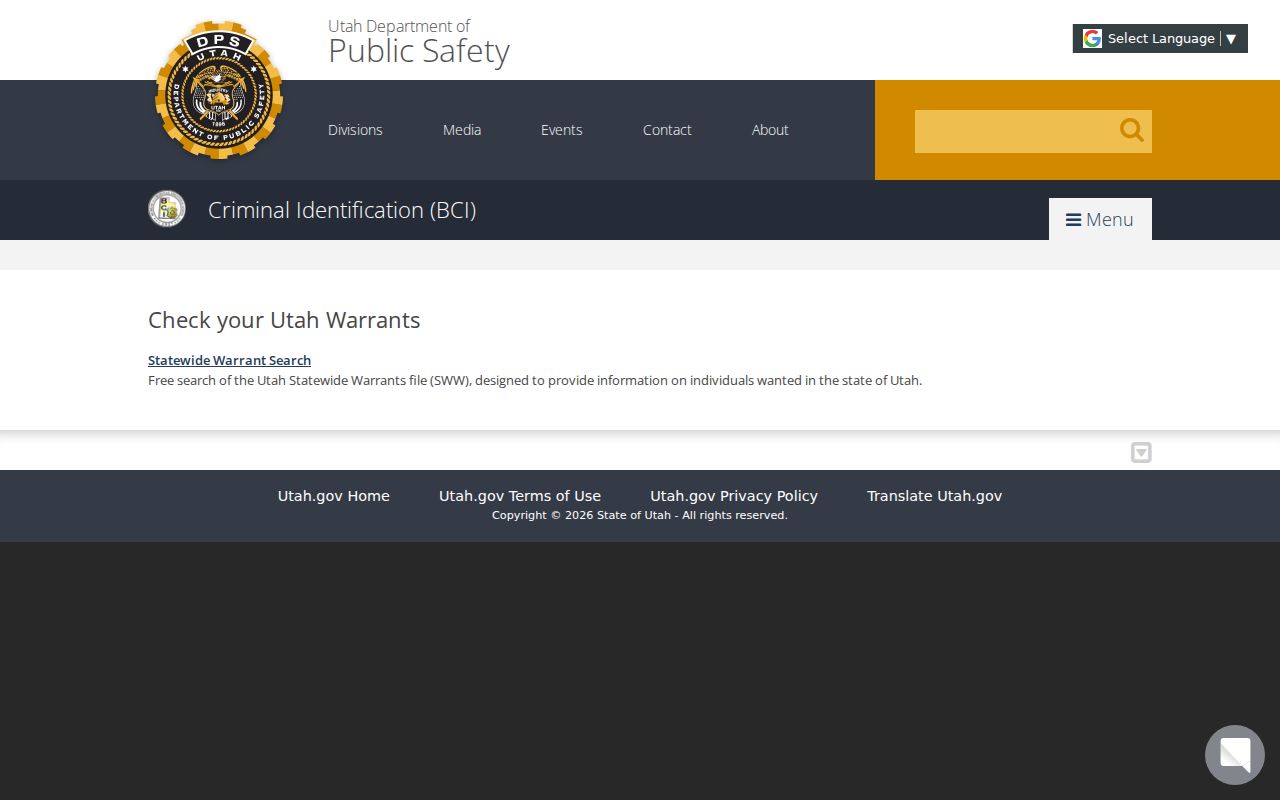
The official BCI page shows the public entry point. It is not proof that every Utah warrant record is present or current.
Utah Warrant Coverage Under State Law
Utah Code §53-10-208 makes BCI maintain the statewide system and spells out what it covers: felony, class A, B, and C misdemeanor warrants, traffic citation failure-to-appear warrants ordered under §77-7-19(3), and certain protective-order records after notice and hearing. The Utah Code provision does not mean every protective order shows up in the public search. BCI's December 2025 manual describes the working SWW file differently, as holding outstanding Utah felony, misdemeanor, and infraction warrants. Statute and manual use different descriptions. Utah's public materials offer no nonparticipant-county list, no searchable start date, no completeness guarantee, and no refresh schedule. A Utah court file remains the place to confirm a case and its status. Note: Utah law defines system categories, but the public record does not guarantee complete or current search results.
How Utah County Warrants Reach the State
A Utah warrant starts life in a court case. The court's record system feeds information into UCJIS, and Justice Courts use a separate method. The serving agency reports its action later. It is a chain of duties, not a promise of instant public updates.
Utah warrant flow: Issuing court records order → CORIS or Justice Court WMS → UCJIS / Statewide Warrants → serving agency reports service → some felony records may also enter NCIC under the agency ORI.
CORIS transfers data electronically to UCJIS. The Justice Court Warrant Management System (WMS) transmits local entries. BCI training describes a felony batch step, then separate NCIC entry for some records. Courts enter, validate, and recall orders; BCI audits quality and trains users; agencies report service. Every hand-off has a different owner, so a Utah sheriff, a clerk, and BCI may each answer a different part of one warrant question.
Utah Warrant Updates and Recall Timing
Utah's public search has no published refresh schedule. The BCI manual assigns timely entry and removal to courts, requires annual validation, and describes BCI audits. Law enforcement reports service, but that update alone does not recall the order in the court case. The Utah BCI December 2025 Statewide Warrants manual says a recalled entry leaves UCJIS within about one hour. A served warrant can linger there for about 15 days if the court has not recalled it. So ask the Utah court whether the case needs another appearance or order, and whether the court record shows recall. A changed public search result is no substitute for that confirmation. Note: Utah's published processing times describe system handling and do not set a guaranteed public-search refresh time.
Fugitive Warrants and the US Marshals
Federal warrants sit outside Utah's state court system. The U.S. District Court for the District of Utah hears federal criminal cases. The U.S. Marshals Service (USMS) carries federal fugitive duties and works with local, state, and federal partners. Its District of Utah office runs VFAST, the Violent Fugitive Apprehension Strike Team, a multiagency operation. Teams operate in Salt Lake City, Ogden, Utah County, St. George, and Vernal. This is a federal fugitive layer. It is not a Utah BCI roster or a state warrant database. For public federal docket records, PACER's District of Utah case lookup is the official route. PACER will not certify that an active federal warrant exists. Sealed process may not appear either. A federal docket search and Utah's BCI name search answer different questions, and neither one replaces confirmation from the court with authority over the case or advice from a lawyer. For district operations, check the official U.S. Marshals District of Utah page. The County Directory route covers state and local courts and sheriffs, not federal case service in Utah.
Utah Court Tiers Behind Warrant Records
Utah District Courts serve as general-jurisdiction trial courts for felony cases across eight judicial districts. County and municipal Justice Courts take many traffic, infraction, local ordinance, and class B or C misdemeanor matters. Juvenile Court stands apart. It carries added privacy limits. The Utah District Courts overview describes the felony tier, and the Utah Juvenile Courts overview describes the juvenile tier in Utah.
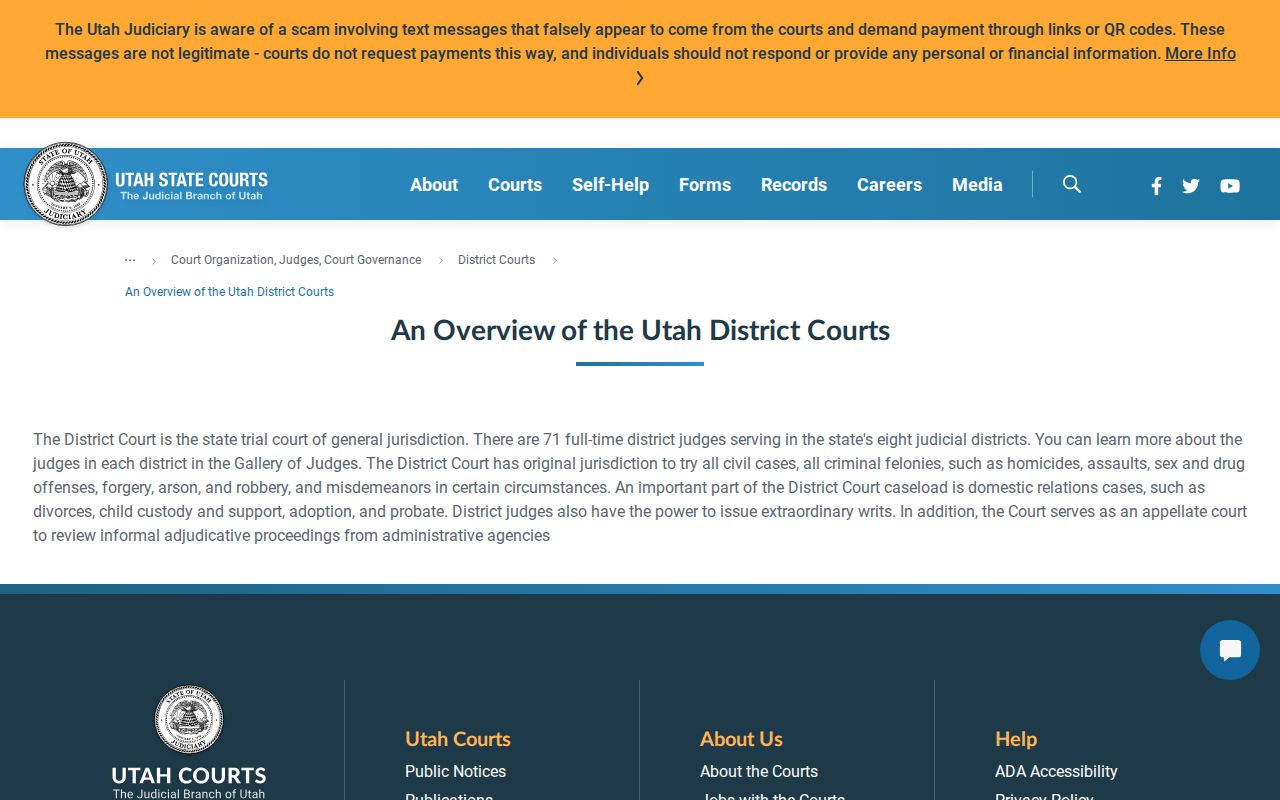
The felony tier is only part of the picture. District Court is not the custodian for a Justice Court or federal warrant, so knowing the division tells you where a Utah warrant lives. District Court handles felonies. County and municipal Justice Courts handle local lower-level matters, and Utah Courts reports 115 of them with 81 judges. Juvenile Court keeps confidential juvenile cases, while the U.S. District Court is a separate federal tier. Those counts describe court structure, not warrants. The official Justice Courts overview explains local jurisdiction and current totals. Note: Utah's court counts describe jurisdictional structure, not the number of active warrants in SWW.
Utah Statewide System vs County List
Utah's statewide index and a county warrant record do different jobs. SWW shares covered Utah records across jurisdictions. The warrant itself stays with the issuing court, and the sheriff or other named agency may handle service. A public county list, where one exists, is another view. It may not include every case. No single layer works as a complete legal clearance.
| Feature | Statewide Index | County and Court Records |
|---|---|---|
| Owner | DPS/BCI administers SWW in UCJIS | The court owns the case; an agency handles service |
| Use | Initial name search across covered state records | Confirm the order, case status, and next step |
| Public view | Limited statewide search; no completeness guarantee | Local methods vary; some records have access limits |
| Action | Identify a possible warrant record | Issuing court recalls or resolves its own warrant |
Use the County Directory to find local court and sheriff routes after a Utah search. A county office can explain service questions. The issuing court confirms its record and handles any recall.
Utah Search-Warrant Counts vs Arrest Warrants
Utah's 2025 Courts Annual Report counts judicial workload, not warrants. In 2024, Utah District Court judges reviewed 18,463 search warrants and 4,624 electronic service-provider (ESP) warrants. Those figures are not active arrest warrants, SWW records, or warrants cleared. The report gives no statewide active arrest-warrant total. The Utah categories are not interchangeable. A search warrant authorizes a search; an ESP warrant seeks electronic-provider information; an arrest warrant authorizes custody under a court order. The Utah Courts 2025 Annual Report provides the source figures and context. Note: Utah's search-warrant review figures do not measure active arrest warrants or public SWW records.
Utah Warrant Technology and History
Utah's warrant technology grew in steps. A 2008 electronic warrant process let law enforcement request warrants remotely while judges reviewed and issued them electronically. CORIS was picked as a common Utah Justice Court case-management system around that period. By 2010, e-payment and e-filing tools had joined wider court technology work. These Utah milestones do not fix the launch date or historical coverage of a public SWW search. Today, court events flow from CORIS or Justice Court WMS into UCJIS, and the public sees only a limited name-search view. The Utah court administrative history records the milestones. In April 2020, BCI training described felony warrant entries from court record systems being uploaded to NCIC under the responsible agency's ORI. That was law-enforcement information sharing, not a public portal launch. NCIC stays restricted to authorized users.
Utah Public Warrant Records and Access
Utah's public SWW search is not the same tool as internal UCJIS and NCIC functions, which stay restricted. Utah Code §53-10-108 limits some criminal-history and arrest-warrant information held by BCI. Courts apply Utah judicial records-access rules, with added limits for sealed and juvenile records. A public result is not a certified docket or release decision. An archived official Utah BCI training screen from 2021 listed first and last name as required, middle initial as optional, and a CAPTCHA before continuing. That snapshot does not confirm the live form's fields today. Internal UCJIS query methods are not public search options.
| Field or Control | Required? | What the Archived Screen Shows |
|---|---|---|
| First Name | Yes | Text entry |
| Last Name | Yes | Text entry |
| Middle Initial | No | Text entry |
| reCAPTCHA | To continue | Human verification control |
| Continue | Button | Advances from the form |
The archived Utah form showed no DOB, county, agency, or warrant-type selector. Those absences describe that document, not today's Utah public form. BCI's official GRAMA request route page covers agency records, though a request does not guarantee access to restricted UCJIS data. For a court case, ask the Utah court that maintains it.
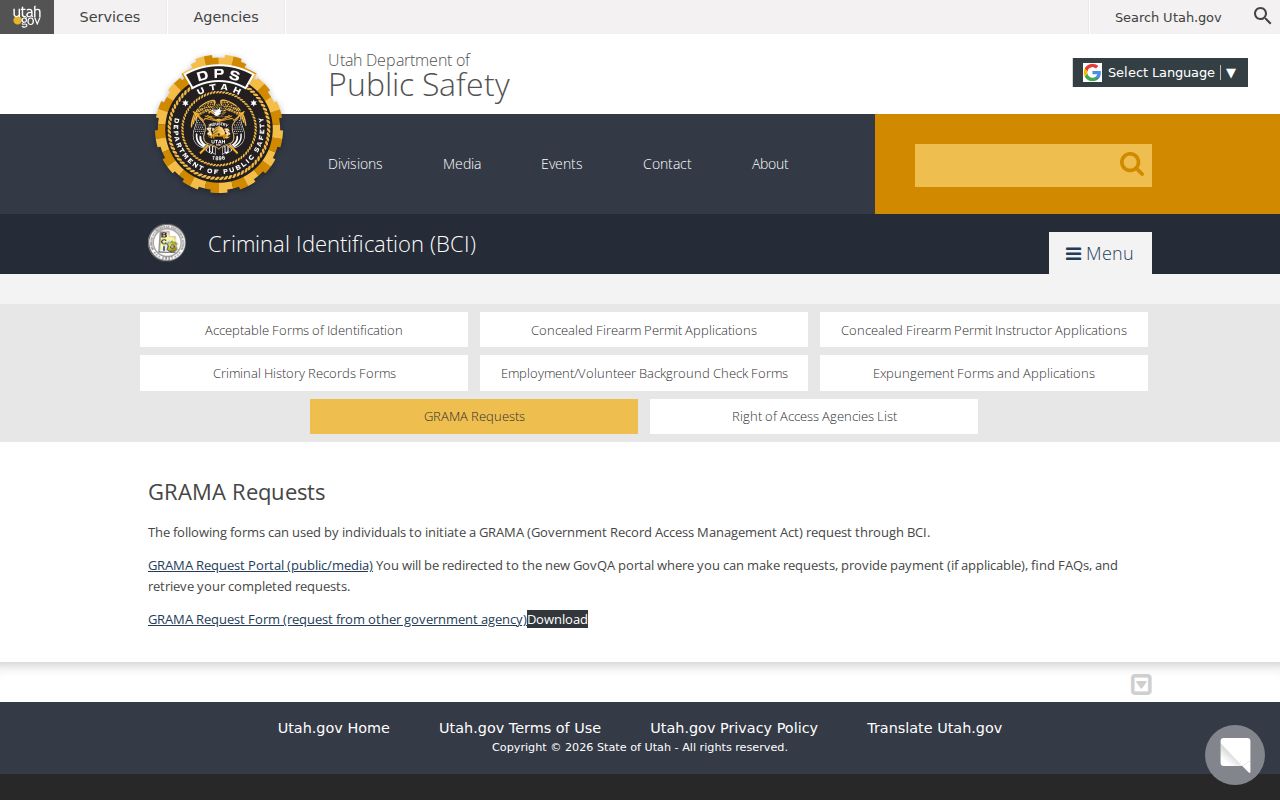
This route only covers what BCI can legally release. For a Utah court warrant, call the issuing court and ask how to view the record and its current status.